AngularFuse: A Closer Look at Angle-based Perception for Spatial-Sensitive Multi-Modality Image Fusion
Xiaopeng Liu, Yupei Lin, Sen Zhang, Xiao Wang, Yukai Shi, Liang Lin
IEEE Sensors Journal, 2026
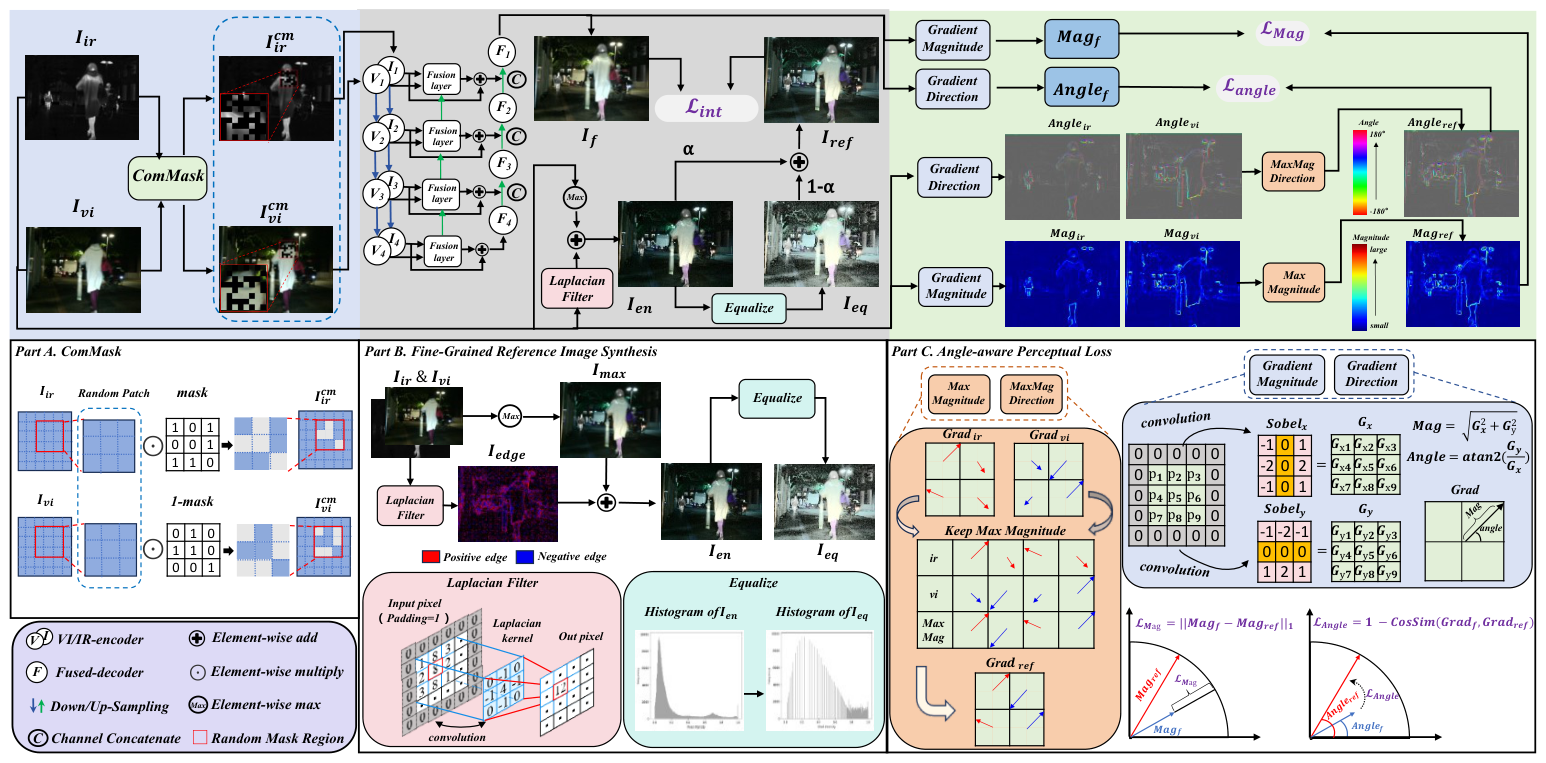
Fig. 1. We call for a closer look at angle-based perception for infrared- and visible- image fusion. The framework contains three parts. (a) Complementary Mask Generation: It takes Iir and Ivi as input and produces incomplete views Icm ir and Icm vi to force the model to borrow information from the other modality. These two views are then sent to the fusion network to obtain If. (b) Fine-Grained Reference Image Synthesis: To obtain a reliable reference, we first apply a Laplacian filter to Iir and Ivi to extract edge detail Iedge. We then blend Iedge with the high-intensity image Imax to produce Ien. Histogram equalization is applied to obtain Ieq and mitigate uneven brightness. The reference image Iref is generated by weighted fusion of Ieq and Ien with ratio α and is used to compute the reference loss Lint. (c) Angle-aware Perception: This module computes gradient magnitudes for infrared and visible images and builds a reference gradient by element-wise maximum. It then compares this reference with the gradient of the fused image If and defines two loss terms LMag and LAngle to improve structural fidelity and detail sharpness.
Overview
Proposes an angle-aware image-fusion framework that constrains both gradient magnitude and direction to preserve texture intensity and edge orientation.